
Smarter Scaffolding with BIM
BIM Scaffolding – The Next Competitive Edge Is Not Steel. It’s Data.
Across the GCC, construction is entering a new phase. Steel, labor, and equipment are no longer the only differentiators. The real shift is happening in how projects are planned, simulated, and executed digitally through BIM scaffolding before a single component reaches the site.

Welcome to the Digitalization Gap
While many manufacturers still focus on physical supply, forward-looking contractors and developers are embracing:
- BIM (Building Information Modeling)
- Digital twin project environments
- Data-driven construction planning
If your scaffolding system is not digitally integrated, it is operationally invisible.
What BIM Scaffolding Means (And Why It Matters)
At its core, BIM is much more than a 3D model. It is a data-rich, intelligent representation of a construction project that integrates:
- Geometry
- Material specifications
- Load data
- Installation sequences
- Lifecycle management
For structural steel, BIM adoption has become standard practice.
For scaffolding, however, adoption remains limited, creating a significant opportunity for companies that move early.
Traditional Scaffolding Planning
- Reactive
- Based on changing site conditions
- Frequently adjusted during execution
BIM-Driven Scaffolding Planning
- Predictive
- Engineered before installation
- Optimized for safety, efficiency, and cost
Digital Twin Construction in the GCC
The GCC is rapidly adopting digital twin construction, particularly on large-scale infrastructure and commercial developments.
A digital twin is a live, data-connected replica of a physical asset that enables:
- Real-time monitoring
- Predictive maintenance
- Scenario simulation
For scaffolding, this means:
- Simulating load conditions before erection
- Planning access routes digitally
- Identifying safety risks before they occur
This aligns directly with the rise of digital twin construction GCC, where temporary works are no longer temporary in planning. Instead, they are fully engineered long before installation begins.
Cuplock & Ringlock in BIM Scaffolding: From Components to Intelligent Systems
Modern scaffolding systems such as Cuplock and Ringlock are inherently modular, making them ideal candidates for BIM integration.
What Digital Integration Looks Like
Each scaffold component becomes a digital data object rather than simply a physical product.
- Standards (Verticals) → Load-bearing capacity data
- Ledgers & Transoms → Structural connectivity data
- Bracing Systems → Stability parameters
- Platforms → Workload distribution
The Result
Scaffolding is no longer simply drawn.
It is digitally engineered with precision.
BIM Scaffolding Digital Design: The Real Business Impact
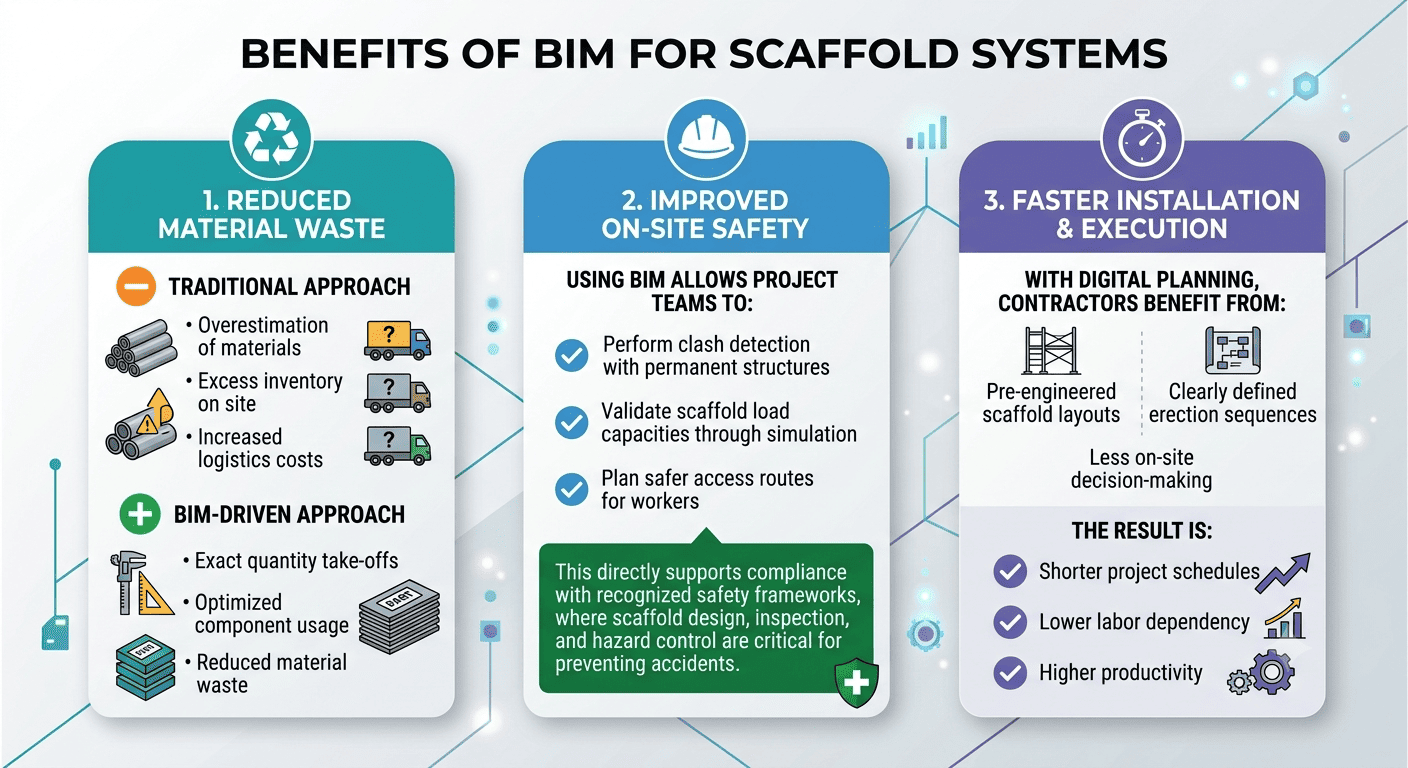
Digital scaffolding design is not just about better visualization. It delivers measurable improvements in project performance, safety, and cost control.
1. Reduced Material Waste
Traditional Approach
- Overestimation of materials
- Excess inventory on site
- Increased logistics costs
BIM-Driven Approach
- Exact quantity take-offs
- Optimized component usage
- Reduced material waste
2. Improved On-Site Safety
Using BIM allows project teams to:
- Perform clash detection with permanent structures
- Validate scaffold load capacities through simulation
- Plan safer access routes for workers
This directly supports compliance with recognized safety frameworks, where scaffold design, inspection, and hazard control are critical for preventing accidents.
3. Faster Installation & Execution
With digital planning, contractors benefit from:
- Pre-engineered scaffold layouts
- Clearly defined erection sequences
- Less on-site decision-making
The result is:
- Shorter project schedules
- Lower labor dependency
- Higher productivity
The Role of ALTRAD SPAR Steel in BIM Integration
This is where ALTRAD SPAR Steel can establish itself as an industry leader.
Rather than being viewed solely as a manufacturer, the company can position itself as a digital engineering partner.
1. BIM Scaffolding-Ready Component Libraries
Provide downloadable BIM assets including:
- Cuplock scaffolding systems as parametric models
- Tube & fitting scaffolding models
- Embedded load ratings
- Connection details
- Engineering specifications
2. Technical Data Integration
Supply complete engineering information including:
- Structural load data
- Material specifications
- Compliance documentation
This enables seamless integration into platforms such as:
- Revit
- Tekla Structures
- Navisworks
- Other scaffolding engineering software
3. Digital Scaffolding Design Support
Offer engineering services including:
- Pre-engineered scaffold layouts
- Project-specific BIM modeling
- Coordination with contractors and consultants
This transforms ALTRAD SPAR Steel from a product supplier into a complete engineering solutions provider.
Structural Steel Modeling UAE: The Missing Link
The UAE and wider GCC have already embraced structural steel modeling UAE practices.
The remaining gap lies in temporary works.
Why This Matters
Scaffolding directly interacts with permanent structures.
Without digital integration:
- Coordination issues increase
- Structural clashes occur
- Project delays become more common
By integrating scaffolding into structural steel modeling workflows, ALTRAD SPAR Steel can:
- Improve project efficiency
- Reduce contractor coordination issues
- Deliver better overall project outcomes
The Procurement Advantage & Closing the Digitalization Gap
As digital construction becomes the industry standard, developers and contractors increasingly expect suppliers to provide more than quality products. BIM compatibility, digital documentation, engineering support, and collaborative workflows are becoming essential procurement requirements. Companies that integrate their products into BIM and digital twin environments will be better positioned to improve project coordination, reduce risks, and support more efficient construction processes.
For ALTRAD SPAR Steel, this presents an opportunity to move beyond being a scaffolding manufacturer and become a trusted digital construction partner. By offering BIM-ready Cuplock and Ringlock systems, integrated technical data, downloadable BIM libraries, and digital scaffolding design support, the company can strengthen its position in digitally driven projects today while building a foundation for future digital twin construction initiatives across the GCC.
Conclusion
Scaffolding is no longer just a temporary structure. It is a critical engineered system operating within an increasingly digital construction environment. The companies that recognize this shift will lead the next generation of construction. Those that do not risk becoming invisible in a market where digital integration is rapidly becoming the standard.